Welcome to this travel blog which is inspired by the wandering clouds effortlessly gliding through distant lands. Sometimes almost still as if watching the beauty of the earth below and at times rushing to some place far away – as if on an endless travel mission. This is where I share my observations, experiences and thoughts gathered during my travels

Showing posts with label Japan. Show all posts

Sunday, September 4, 2011

Scientists in Steel


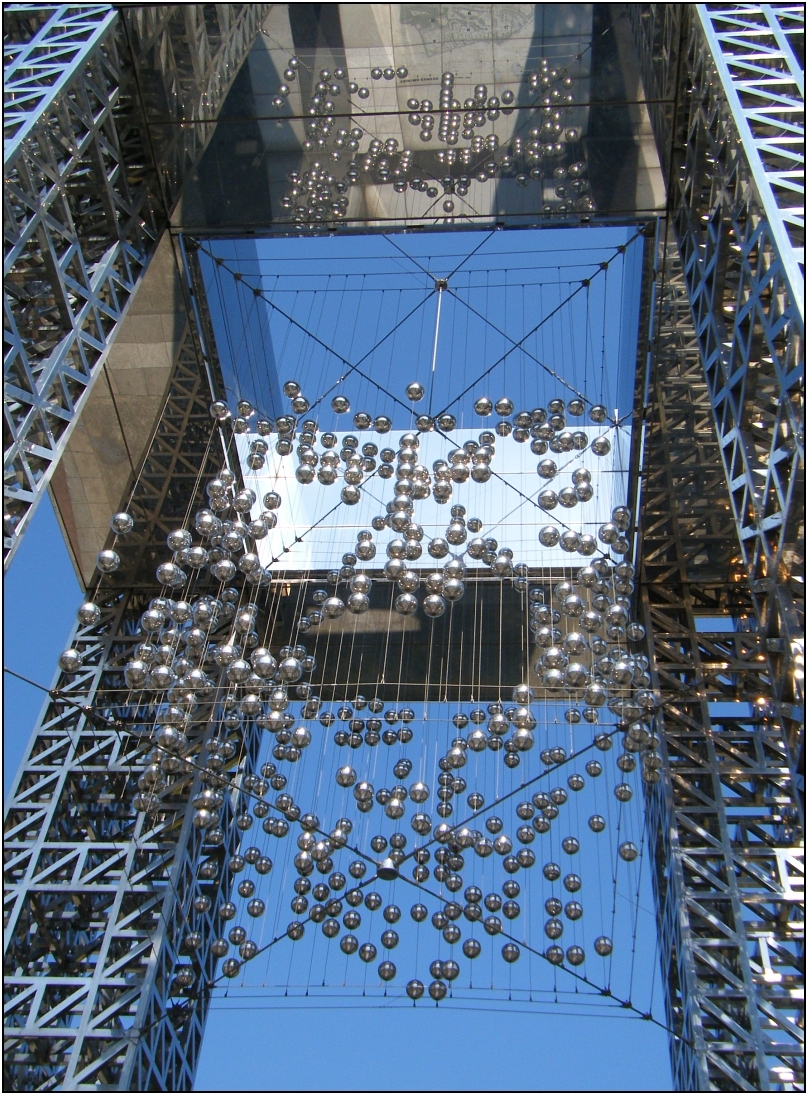
Just outside the Tsukuba Expo Memorial Park in Ibaraki, Japan, there is an amazing stainless steel installation that keeps up with the city’s reputation as the Science City. Constructed with the help of hundreds of steel balls suspended from a square frame, images of four great scientists namely, Archimedes, Newton, Edison and Galileo, have been created. 

View from below the structure
The square frame rests on four polished steel pillars and on the top it has connected the diagonals and the sides. Hundreds of steel balls are suspended with the help of thin but strong wires from top in such a manner that faces of the four scientists can be identified by looking at the installation from each of the four sides. The most amazing part of this installation is that when one looks at say Galileo from one side, the other steel balls making the images of other scientists are not even visible because they are integrated into the design of Galileo. The design is extremely neat and without any distortion although it simultaneously showcases four images facing four different sides. I thought, perhaps if I stood under the square frame and looked up I would get to see some messiness of the artist, but I was wrong. It was impeccable and absolutely Japanese. Although I am unable to find the details of the creators in my notes, my strong hunch is that it must have been a team effort, that too an inter-disciplinary team effort. 
Image of Galileo


The team would have relied on first, the artist or designer for conceiving and visualizing the installation, then the people with backgrounds in math, computer graphics, 3D modeling to come up with simulated virtual models, then the people with background in material sciences in helping select material that has withstood the weather conditions and then finally those who actually worked on it hands-on to erect the structure and translate the designer’s vision into a reality.  Kudos to the team which has beautifully converged multiple disciplines and for a flawless execution that brings the four great scientists together!

Thursday, August 25, 2011

A bicycle ride under blooming Sakura


In early April, when the Cherry Blossom trees are in full bloom in Japan, it is a common practice to go out for flower viewing called ‘Hanami’ or hold lawn parties under fully blossomed trees. Since I did not have anyone to party with, I decided to go around enjoying the Sakura on a bicycle. It was not very difficult to rent a bicycle at the local train station. I just had to cross two hurdles- one, filling up a Japanese form which I managed to do with some help from two kind-hearted elderly women who barely knew English and two, after being given the key to the bicycle I actually managed to find the right bicycle from hundreds parked at the cycle stand. I knew the route I had to take, but once I got on the road, I decided to keep the maps away and wander aimlessly under the Sakura.

The weather was beautiful. Bright sunshine passing through thick branches of blooming Sakura created a play of light and dark on the pathway. Every now and then, the cool breeze nudged the petals to leave home and carried them delicately as they twirled and danced to silent music till they rested on the earth. Every time I passed through this rhapsody, I stood there with my face turned upwards and my palms stretched out so that I could feel the petals falling on my skin. Can there be anything more flattering than being showered by the Sakura petals or the ‘Hanafubuki’ as the showers are called in Japanese? I rode through the Tsukuba University campus and found many people merrily stretching out on the lawns- some were playing music, some were reading and some were even barbequing! It seemed like no one could turn down the invitation extended by bright sunshine and the pink hued-cloud shaped Cherry Blossoms to come outdoors and have a nice time.

I cycled through the small lanes finding spots where I could enjoy the Hanafubuki and then rode through the boulevards that were graciously lined by Sakura on both sides. As it started getting dark, I realized that I had to go back and return my rented bicycle. I handed over the keys and told the lady at the counter that I would need the bicycle again the next day. I had enjoyed the Sakura show and wanted to experience it once again. You see, there are some things in life that one can’t get enough of.

Sunday, August 21, 2011

Hugs to Paro


The Japanese are well known for their advanced contribution to robotics, engineering and technology. The Science Square at the National Institute of Advanced Industrial Science and Technology (called AIST) at Tsukuba, Japan showcases a stunning range of state-of-the-art robots that have been designed to serve various purposes. There are the HRP 2P and HRP 3P humanoid robots that can carry out various tasks like humans; they can walk even on slippery and uneven surfaces, dance, sit down, get up after falling and pick up objects. They can do useful chores like sorting and stacking plates of difference sizes and bowls. They have robots that can detect and anticipate movement of objects in the surroundings and respond accordingly. There is also a robotic version of the Tyrannosaurus which walks and is meant for commercial use in the entertainment industry.

However, the biggest attraction at the Science Square is Paro, a robotic baby harp seal, which has been recognized as the world’s most therapeutic robot. With a pacifier in its mouth and having the most vivid and expressive eyes, Paro can evoke soft and tender emotions in any person. Under the soft white fluffy body are fitted numerous sensors that allow Paro to respond to auditory, temperature, tactile, light and postural stimuli. Paro can recognize when it is taken on one’s lap and is patted and is programmed to make certain kinds of sounds. It turns its head, waggles its tail, and blinks with its long eyelashes. It loves to be cuddled and talked to and responds in various ways when it is shown affection. Paro has been effectively used in therapy with children and the elderly. For developing Paro, scientists used research in psychology and animal therapy and studied how stress and depression could be reduced in patients, especially in situations when use of real animals may not be advisable or possible.

I felt like bringing Paro home. Perhaps I may have to some day, if I end up getting old and lonely. 

Monday, June 20, 2011

Runners, runners, everywhere...

What is common between Senegal and Japan? I would say, the sight of ordinary people (and perhaps also some professional athletes), running on the streets and main roads, at anytime of the day! Young and old, men and women, in groups or as singles and really at any time of the day! In many countries, the cheapest and the most common form of exercise is running, especially long distance running because it helps to build stamina and endurance. Ordinary people running for physical fitness in large numbers creates a unique fitness culture and I often wonder what constitutes the “fitness culture” of my city?

A few years ago, I was visiting Dakar, Senegal and one of the sights that amazed me was that of runners under the hot afternoon sun with their glistening muscular bodies and long legs effortlessly running in almost a rhythmic fashion. A couple of my friends also decided to go running around Dakar in the morning and I really regretted not carrying my running shoes and a pair of track-pants. Then later the following year when I was visiting Tsukuba, Japan, the emphasis given to physical fitness by ordinary people of all ages was like an eye-opener. At any time of the day, the streets and parks have runners, of all ages, with ear phones on, doing their regular rounds. This time in Tsukuba, I had carried my shoes and was therefore able to immerse myself in the “fitness culture” of the place.

Every place has its own specific “fitness culture”. If one wants to understand and experience the place as a traveler (and not just as a tourist), slipping into the local “fitness culture” offers unique sights as well as insights. Burning of calories is an incidental bargain.